Types of Turnstile Gates Explained: The 2026 Guide to Secure Access Control
What is a Gate Turnstile?
At its core, a gate turnstile is a pedestrian access control device that lets one authorised person through at a time. It physically blocks tailgating, stops unauthorised entry, and keeps foot traffic moving in a controlled, predictable way.
What separates a turnstile from a regular door or barrier is enforcement. Pair it with an RFID card reader, a biometric scanner, or a facial recognition terminal and it becomes an intelligent checkpoint. No valid credential, no entry. Simple as that.
You will find gate turnstiles in corporate lobbies, metro stations, stadiums, factories, schools, government buildings, and leisure attractions. Choosing the right one comes down to four things: how secure the site needs to be, how many people pass through daily, the available space, and what the entry area should look like.
Security hierarchy (high to low): Full-Height Turnstile, Speed Gate, Swing/Flap Barrier, Tripod Turnstile. Pick based on the real-world consequence of someone getting through without authorisation, not just what fits the budget.
4 Main Types of Gate Turnstile
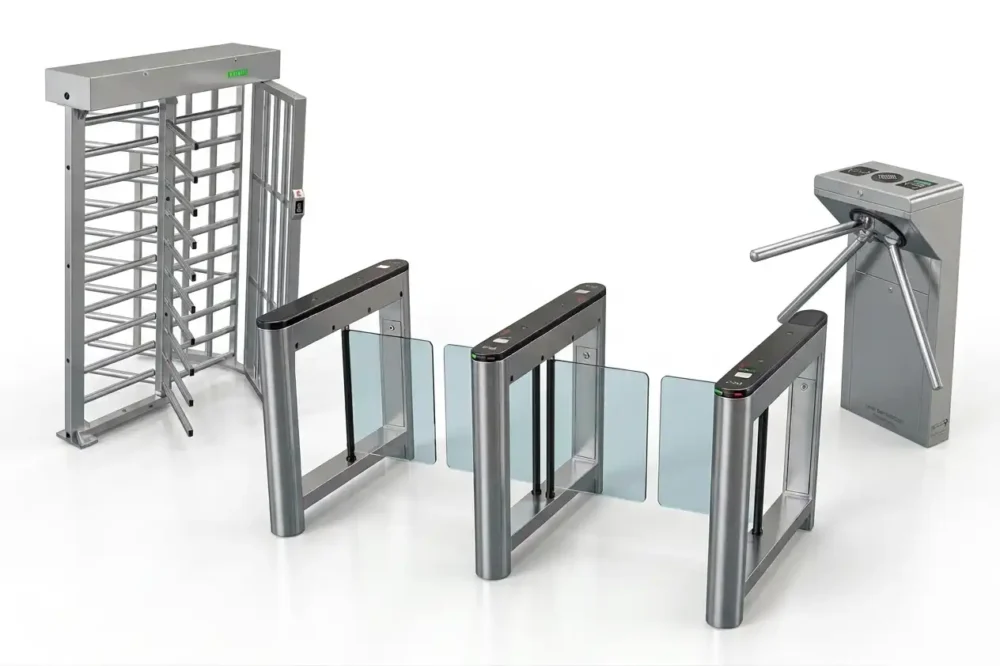
Despite the huge range of brands and finishes on the market, virtually every pedestrian turnstile falls into one of four categories. Here is what each one actually does and where it works best.
1. Tripod Turnstile
Three rotating stainless steel arms form a triangle that turns 120 degrees per authorised pass. It is the most straightforward and affordable option available, and for many applications, it is all you need. If you are managing a gym entrance, a construction site, or a sports facility where aesthetics are not the priority, a tripod turnstile does the job reliably and at a fraction of the cost of other types.
- Lowest cost per lane
- Compact footprint, easy to fit in tight spaces
- Built to handle outdoor conditions
- Low maintenance with straightforward mechanical design
2. Flap Barrier Gate
Retractable acrylic or tempered glass flaps extend across the lane and snap back in around 0.2 seconds once a valid credential is presented. This is by far the most popular choice for corporate offices, banks, and transit hubs, and for good reason. It handles high volumes smoothly, looks professional, and integrates cleanly with almost any access control system.
- Fastest throughput of any type, around 55 persons per minute
- Sleek glass or acrylic finish suits modern interiors well
- Anti-pinch sensors protect users throughout the cycle
- Opens automatically on power loss for safe evacuation
3. Swing Gate Turnstile
A full-width barrier that swings open, much like a conventional gate. The key advantage here is passage width. Swing gates can open anywhere from 600mm to 1500mm, making them the only practical choice when you need to accommodate wheelchairs, pushchairs, luggage trolleys, or bicycles. They are also frequently used for VIP lanes where a more welcoming, unhurried entry experience matters.
- Widest passage of any turnstile type, fully ADA and DDA compliant
- Handles bulky items that other turnstiles simply cannot
- Quiet motor operation with smooth, controlled movement
- Can be configured for bi-directional or entry-only use
4. Speed Gate / Full-Height Turnstile
Speed gates use tall glass panels, sometimes up to 1.8 metres high, to create a near-complete physical barrier. Climbing over one is not a realistic option. Full-height turnstiles go a step further, extending from floor to ceiling for environments where perimeter security is non-negotiable. Think data centres, embassies, military sites, and critical infrastructure.
- Genuine anti-climb and anti-tailgate protection
- Impressive visual presence that suits premium lobby environments
- Supports multi-factor authentication setups
- Full-height models are well suited to outdoor perimeter use
Side-by-Side Comparison
Here is a quick reference table covering the specs that tend to matter most during the specification stage.
| Feature | Tripod | Flap Barrier | Swing Gate | Speed / Full-Height |
|---|---|---|---|---|
| Security Level | Basic | Medium | Medium | High to Maximum |
| Throughput | ~25 ppm | ~55 ppm | ~30 to 40 ppm | ~30 to 45 ppm |
| Lane Width | ~550mm | 550 to 990mm | 600 to 1500mm | 550 to 900mm |
| Wheelchair Access | No | Yes (wide lane) | Yes | Model-dependent |
| Anti-Tailgating | Good (mechanical) | Excellent (sensor) | Good (sensor) | Excellent |
| Indoor Use | Yes | Yes | Yes | Yes |
| Outdoor Use | Yes | IP-rated models | IP-rated models | Yes (full-height) |
| Relative Cost | $ Low | $$ Mid | $$ Mid | $$$ Premium |
| Aesthetics | Functional | Sleek / Modern | Professional | Premium / Imposing |
Best Applications by Sector
Security needs vary significantly across industries. What works perfectly for a corporate office lobby would be completely wrong for a labour camp perimeter. Below is a practical reference for the most common use cases we see across the UAE and GCC region.
| Sector | Recommended Type | Key Reason |
|---|---|---|
| Corporate Office Lobby | Flap Barrier or Speed Gate | High throughput, professional finish, RFID or biometric ready |
| Metro / Transit Station | Flap Barrier Gate | Highest ppm of any type, compact enough for multi-lane corridors |
| Data Centre / Embassy | Speed Gate or Full-Height | Anti-tailgate, anti-climb, supports multi-factor authentication |
| Labour Camp / Industrial Site | Full-Height Turnstile | Tamper-resistant, all-weather, perimeter-grade physical control |
| School / University | Tripod or Swing Gate | Cost-effective across multiple entry points, safe for student use |
| Hospital / Healthcare | Swing Gate | Wheelchair and stretcher clearance, hygienic material options |
| Gym / Sports Club | Tripod Turnstile | Robust, compact, enforces strict one-in one-out membership access |
| Tourist Attraction / Theme Park | Tripod or Flap Barrier | Ticket validation at volume, reliable crowd flow management |
| Airport Immigration Hall | Speed Gate (wide lane) | Luggage clearance, biometric e-passport integration |
Integration with Access Control Systems
A turnstile on its own is just a mechanical gate. The real capability comes when it is connected to an access control platform. At that point it becomes part of a broader security ecosystem, sharing data with your visitor management software, time and attendance system, or enterprise identity platform.
Modern turnstiles communicate over Wiegand, OSDP, RS-485, or TCP/IP interfaces and are compatible with a wide range of credential types:
- RFID / Proximity Card
- Smart Card (DESFire, HID iCLASS)
- Fingerprint Biometric
- Facial Recognition
- QR Code / Barcode
- Palm Vein Reader
- Mobile Credential (BLE / NFC)
- PIN Keypad
- Ticket / Barcode Scanner
- ESD Testing Module
- Visitor Management System
- Time and Attendance Platform
At ID Vision, we supply and integrate gate turnstiles with leading Access Control Brands including HID Global, Suprema, IDEMIA, ZKTeco . Whether you are fitting out a single entrance or rolling out a multi-site deployment across the GCC, our team manages the entire project from initial site survey through to commissioning and handover.
UAE note: For government buildings and critical infrastructure projects, your access control setup may need to align with UAE PASS digital identity standards or meet SIRA (Security Industry Regulatory Agency) requirements in Dubai. Get this confirmed early in the specification process. Our team can advise before you commit to a system.
How to Choose a Gate Turnstile: A 6-Step Process
With dozens of brands, models, and configurations available, it is easy to get overwhelmed. Here is the process our consultants work through when specifying turnstiles for projects across the UAE, Saudi Arabia, and Africa. Following these steps in order will save you from making an expensive mistake.
- Define your actual security requirement
Is this a public-facing entrance, a corporate reception, a restricted server room, or an outdoor perimeter? The answer shapes everything else. Be honest about the risk level. A lobby that looks secure but fails to prevent tailgating is a liability, not an asset. - Work out your peak hour traffic numbers
Count or estimate the number of people moving through during the busiest 15-minute window of the day, then scale to an hourly figure. Divide that by the throughput rating of your chosen turnstile type to calculate how many lanes you need. Getting this wrong is one of the most common and avoidable project mistakes we see. - Check your accessibility obligations
Any facility open to the public in the UAE needs at least one accessible lane. A standard tripod at 550mm does not meet this requirement. Plan for a swing gate or wide-lane flap barrier from the beginning, not as an afterthought. - Look at the environment honestly
Outdoor or semi-covered installations in the UAE need IP65-rated enclosures as a minimum and 316L stainless steel cabinets to handle coastal humidity and salt air. Electronics also need to be rated for ambient temperatures above 55 degrees Celsius. Do not assume a standard indoor unit will survive a Dubai summer outdoors. - Decide on your credential technology before choosing the hardware
The authentication method, whether that is a card, fingerprint, face, mobile, or a combination, determines which reader you need and how it mounts on the turnstile. Locking in the turnstile first and then trying to retrofit a reader rarely ends well. Confirm Wiegand or OSDP compatibility with your access controller before anything is ordered. - Budget for total cost of ownership, not just the hardware
Factor in installation, cabling, integration, training, and ongoing maintenance. A tripod turnstile might cost a fraction of a speed gate upfront, but if it needs more frequent servicing over five years, the gap closes quickly. Premium units typically offer lower OpEx over their lifetime.
Installation Considerations for the UAE
Beyond the standard installation process, there are a few UAE-specific factors worth addressing early. These come up regularly on our projects and can cause delays if they are left until the last minute.
- Power supply: UAE mains runs at 220 to 240V / 50Hz. Each turnstile lane should have its own dedicated, protected circuit from the DB panel. Confirm the power draw per unit and plan the electrical accordingly.
- Floor preparation: Turnstiles need a level, solid floor. Some models require embedded conduit for cabling. Coordinate with your fit-out contractor well before installation day, otherwise you are looking at delays and extra cost.
- Heat and humidity: For anything outdoors or in unconditioned spaces, specify IP65 enclosures and ensure electronics are rated for 60 degrees Celsius or above. This is not optional in the UAE climate.
- Fire egress compliance: UAE Civil Defence and NFPA standards require all turnstiles to fail-safe open when a fire alarm triggers, clearing every lane instantly. This needs to be wired directly into your BMS or fire alarm panel and tested before handover.
- SIRA compliance: Dubai projects involving security systems typically require SIRA-approved products and a licensed integrator. ID Vision is fully compliant and operates across all seven emirates.
- Brands : ID Vision provides a comprehensive range of premium entrance control solutions in the UAE, featuring industry-leading brands such as Magnetic, PERCo, Tansa, TiSO, Optima, and Sectec, ZKTeco & Özak .
Frequently Asked Questions
What is the difference between a flap barrier and a speed gate?
The main difference is barrier height, and that matters more than people realise. A flap barrier uses short horizontal panels, typically waist height, that retract from the cabinet sides. A speed gate uses full-height glass panels up to 1.8 metres tall, which makes climbing over it genuinely impractical rather than just inconvenient. If anti-tailgate performance is a serious requirement rather than a box-ticking exercise, speed gates are the stronger choice. They cost more, but the security gap between the two is significant.
How many people per minute can a flap barrier handle?
Under good conditions, a single flap barrier lane will process around 40 to 55 persons per minute. Tripod turnstiles run closer to 25 ppm, and swing gates sit between 30 and 40 ppm. For high-volume sites like metro stations or large office buildings, multiple flap barrier lanes running in parallel is the standard approach. If you are unsure how many lanes you need, our team can run the numbers based on your peak hour headcount.
Can gate turnstiles be used outdoors in the UAE climate?
Yes, but you need to specify correctly. The two things that catch people out most often are corrosion and heat. For coastal or humid environments, 316L stainless steel cabinets are worth the premium over standard 304 grade. Electronics should be rated for high ambient temperatures, and the enclosure should be IP65 at minimum. Full-height turnstiles tend to be the most durable choice for outdoor perimeter use given their robust mechanical construction. Always ask the supplier for a full datasheet, including operating temperature range, before committing.
Which turnstile is best for a wheelchair-accessible building?
Swing gates, without question. Lane widths of 600mm to 1500mm give you plenty of clearance for wheelchairs, pushchairs, and luggage. Wide-lane flap barriers at 900mm or more are also workable. A standard tripod at 550mm does not meet UAE building regulations or ADA guidelines, which require a minimum of 815mm clear passage for wheelchair access. If you are fitting out a facility that the public can access, at least one compliant lane is a legal requirement, not a preference.
What access control brands are compatible with your turnstiles?
We regularly integrate with HID Global (iCLASS SE, OMNIKEY), Suprema (BioStation series), IDEMIA (MorphoWave, VisionPass), ZKTeco, Thales, and Feitian. The majority of quality turnstiles communicate via Wiegand 26/34 or OSDP, which covers most controllers and readers on the market. That said, compatibility should always be confirmed before the project is signed off rather than assumed. Our technical team does this validation as part of the standard proposal process.
What happens to the turnstile during a power cut or fire alarm?
All quality turnstiles are designed to fail-safe open, meaning every barrier retracts automatically when power is lost or a fire alarm signal is received. This is a UAE Civil Defence requirement and a non-negotiable life safety feature. Some models include a built-in UPS to maintain controlled access for a period after power loss before defaulting to open. Always confirm the fail-safe behaviour in writing before purchasing, and make sure it is tested as part of your commissioning sign-off.
How long does installation typically take?
For a standard two to four lane setup in a pre-prepared location, mechanical installation takes about one to two days. Access control integration, testing, and commissioning typically adds another day on top of that. More complex projects involving embedded floor conduits, multi-system integration, or large lane counts will take longer. We provide a detailed project schedule as part of every proposal so you can plan your site access and operational handover dates accordingly.