Iris Recognition vs Retina Recognition
Iris Recognition vs Retina Scanning: What Is the Real Difference?
Both technologies scan the eye. Both deliver exceptional accuracy. Yet they work on entirely different anatomical structures- and one is nearly obsolete for access control while the other powers border security across the entire UAE.
This guide breaks down exactly how each technology works, where the differences actually lie, and which one belongs in your facility or identity programme.
Quick Answer
Iris recognition captures the unique coloured ring at the front of your eye using an infrared camera from a comfortable distance- non-invasive, fast, and commercially viable at scale. Retina scanning maps the blood vessel network at the back of the eye by directing an infrared beam deep inside it- extremely accurate, but invasive, expensive, and rarely encountered outside medical imaging or ultra-secure government installations. For access control in 2025, iris recognition is the clear choice.
Table of Contents
- Why People Confuse the Two
- The Anatomy: Iris vs Retina
- How Each Technology Works
- Full Comparison Table
- Accuracy and False Match Rates
- Real-World Applications
- Iris Recognition in the UAE
- Which Should You Choose?
- Frequently Asked Questions
Why People Confuse the Two
Iris recognition and retina scanning are both ocular biometric technologies- they use the human eye to uniquely identify a person. That single commonality causes widespread confusion, even among security professionals.
The problem is compounded by language. In everyday conversation, people say “retinal scan” when they almost always mean an iris scan – whether referring to a smartphone’s iris unlock feature, an airport immigration booth, or a corporate access reader. In the vast majority of real-world deployments, what people are describing is iris recognition. True retinal scanning is almost never encountered outside of ophthalmology clinics and classified government facilities.
The distinction matters practically: the two technologies differ significantly in how they work, how much they cost, how users experience them, and what problems they solve.
The Anatomy: Iris vs Retina
Before comparing the technologies, it helps to be precise about the anatomy. The iris and retina are two entirely different parts of the eye, located at opposite ends.
The Iris: The Coloured Ring at the Front
The iris is the visible coloured structure surrounding the pupil. It controls how much light enters the eye by expanding or contracting the pupil in response to lighting conditions. Crucially, the iris is the only internal organ of the human body visible from outside without any instruments- which makes it uniquely suited to non-invasive biometric capture.
- Location: Front of the eye, fully visible
- Unique data points: 255+ measurable features
- Stability over time: Stable from birth throughout life
- Affected by disease: Rarely
- Identical twins: Different patterns between twins
The Retina: The Blood Vessel Network at the Back
The retina is a thin layer of light-sensitive neural tissue lining the back of the eye. Its dense network of blood vessels converts incoming light into neural signals sent to the brain. The pattern is so intricate that even identical twins have entirely unique retinal maps.
- Location: Back of the eye, completely hidden
- Unique data points: Approximately 40 reference features
- Stability over time: Generally stable, but disease-dependent
- Affected by disease: Yes- diabetes, glaucoma, hypertension can alter the pattern
- Identical twins: Different patterns between twins
How Each Technology Works
The fundamental difference between iris recognition and retina scanning is where in the eye the system looks, and the method it uses to read that information.
How Iris Recognition Works
- An infrared camera captures a high-resolution image of the iris from 3 to 40 cm away – or up to several metres with advanced long-range systems.
- The system detects the boundaries of the iris and pupil, isolating the iris ring and filtering out eyelashes and light reflections.
- Mathematical algorithms – Daugman’s IrisCode is the dominant industry standard – analyse the 255+ unique texture features encoded in the iris pattern.
- A compact digital template (the IrisCode) is generated and compared against enrolled templates at speeds of millions of comparisons per second per CPU core.
- Liveness detection verifies a living eye by monitoring pupil dilation response to variable infrared illumination, defeating spoofing attempts using photographs or prosthetics.
How Retina Scanning Works
- The subject must position their eye directly against a scanning eyepiece- similar in experience to looking through a microscope – and hold steady throughout the entire capture.
- A low-energy infrared beam is directed through the pupil and traces a standardised circular path across the retinal surface at the back of the eye.
- Retinal blood vessels absorb IR light more than surrounding tissue, creating a distinctive reflectance pattern across the scan path.
- This variation pattern is digitised and converted into a biometric template capturing approximately 40 unique reference points.
- The template is compared against a database. The process is highly accurate, but slow and user-discomforting relative to iris recognition.
Important distinction: Iris recognition analyses the texture pattern of the iris- not the colour. A green iris and a brown iris can produce identical IrisCodes in theory. The technology works equally reliably across all ethnicities and eye colours.
Full Comparison: Iris Recognition vs Retina Scanning
| Criteria | Iris Recognition | Retina Scanning |
|---|---|---|
| Part of eye used | Iris (coloured ring, front of eye) | Retina (blood vessels, back of eye) |
| Scan method | Infrared camera photograph | IR beam directed through pupil |
| User experience | Non-invasive – glance at camera | Invasive – must hold eye at eyepiece |
| Capture distance | 3 cm to several metres | Must be at eyepiece (approx. 2 cm) |
| User cooperation required | Minimal | High- must remain completely still |
| Unique data points | 255+ features (IrisCode) | Approx. 40 features |
| False Accept Rate (FAR) | Near zero at scale | Approx. 0.0001% |
| Authentication speed | Under 1 second | 5 to 10 seconds per person |
| Affected by illness | Rarely- iris is resilient | Yes- diabetes, glaucoma, hypertension |
| Stability over time | Stable from birth | Generally stable, disease-dependent |
| Works with glasses | Yes- IR penetrates clear lenses | No- glasses must be removed |
| Works with contact lenses | Modern systems: yes (except cosmetic) | No- contacts must be removed |
| Hardware cost | Mid-range, commercially available | Very high, specialist only |
| Commercial deployment | Widespread globally | Extremely rare |
| Primary use cases | Access control, border security, national ID | Medical imaging, government labs |
| Mobile device use | Yes- Samsung, Apple Vision Pro | No- hardware far too complex |
Accuracy and False Match Rates
Both technologies achieve a level of accuracy that dwarfs other biometric modalities. In practical terms, both are considered essentially impossible to defeat through coincidental match- even across populations of hundreds of millions of people.
Retina scanning’s False Accept Rate of approximately 0.0001% was long cited as the gold standard in biometric accuracy. However, iris recognition matches- and in large-population deployments, surpasses- this benchmark because of the mathematical richness of Daugman’s IrisCode. With over 255 unique features encoded per eye, iris systems can be searched against billions of enrolled templates with statistically near-zero collision probability.
There is also a significant practical caveat for retina scanning: disease can alter the retinal blood vessel pattern over time. Conditions including diabetes, glaucoma, high blood pressure, and retinal degenerative disorders can modify the retina, potentially causing false rejections for enrolled users. This is a serious operational concern for any long-term deployment. The iris, by contrast, is a well-protected structure that remains remarkably stable throughout life, even in the presence of most systemic medical conditions.
Real-World Applications
The practical gap between these two technologies becomes most visible when looking at where each one is actually deployed.
Common Uses of Iris Recognition
- Border control and immigration checkpoints
- Corporate office and data centre physical access
- National identity programmes (UAE, India’s UIDAI Aadhaar)
- Time and attendance in high-security facilities
- Banking and financial services authentication
- Healthcare patient identification
- Prison and correctional facility management
- Smartphone unlock (Samsung Galaxy series, Apple Vision Pro)
- Automated Border Control (ABC) e-gates at airports
- Refugee registration and humanitarian aid distribution
Common Uses of Retina Scanning
- Ophthalmology and optometry examinations
- Medical detection of systemic disease markers
- Intelligence agency identity verification (historical FBI, CIA use)
- Military and defence laboratory access
- Nuclear facility personnel identification
- High-security government vault access
The asymmetry is telling. Iris recognition is used commercially across billions of people worldwide. Retina scanning’s deployment base is tiny by comparison- largely confined to intelligence agencies, defence installations, and medical imaging environments. The primary barrier to wider retina adoption is not accuracy: it is user experience and hardware cost.
Iris Recognition in the UAE: A World-Leading Deployment
The UAE operates one of the most significant iris recognition deployments anywhere in the world. All 32 air, land, and sea ports use iris recognition to screen every visa-requiring traveller entering the country. The system cross-references a shared GCC watchlist, and over a decade accumulated more than 62 trillion iris cross-comparisons- a scale no other biometric modality has approached in border security.
This deployment is built on Daugman’s IrisCode algorithm- the same mathematical foundation used in commercial access control products from vendors including HID Global, IDEMIA, and Thales. The same algorithms screening millions of travellers daily through Dubai International Airport can be integrated into a corporate office or facility access system.
The UAE’s national use of iris recognition for border control means the region carries significant technical expertise and established infrastructure around the technology. Iris-capable readers from brands like HID Global, IDEMIA, and Suprema integrate directly with UAE-deployed access control platforms through standard Wiegand and OSDP interfaces.
Which Should You Choose for Your Project?
For virtually every commercial, institutional, or government access control project, the answer is iris recognition. Retina scanning is not a viable consideration for access control: hardware is prohibitively expensive, the user experience is invasive and slow, and commercial-grade products simply do not exist at scale.
When Iris Recognition Makes Sense for Your Facility
- High-security zones where card cloning or PIN sharing is a concern- iris credentials cannot be shared, stolen from a pocket, or forgotten.
- Hygiene-sensitive environments such as hospitals, pharmaceutical cleanrooms, and food production facilities- contactless authentication eliminates surface transmission risks.
- High-traffic entry points where authentication speed matters- iris recognition processes in under one second, maintaining throughput at peak hours.
- Large enrolled populations such as labour camps, universities, and large corporate campuses- 1:N identification across thousands of records is accurate and fast.
- Outdoor or all-weather installations where fingerprint readers fail due to dirty, wet, cut, or calloused hands.
Our Recommendation
Choose iris recognition for access control, time and attendance, border management, and identity verification. The technology is non-invasive, fast, stable, contactless, and highly accurate- available from proven brands including HID Global, IDEMIA and Suprema. Reserve retina scanning discussions for medical imaging contexts only: it has no practical role in physical or logical access control today.
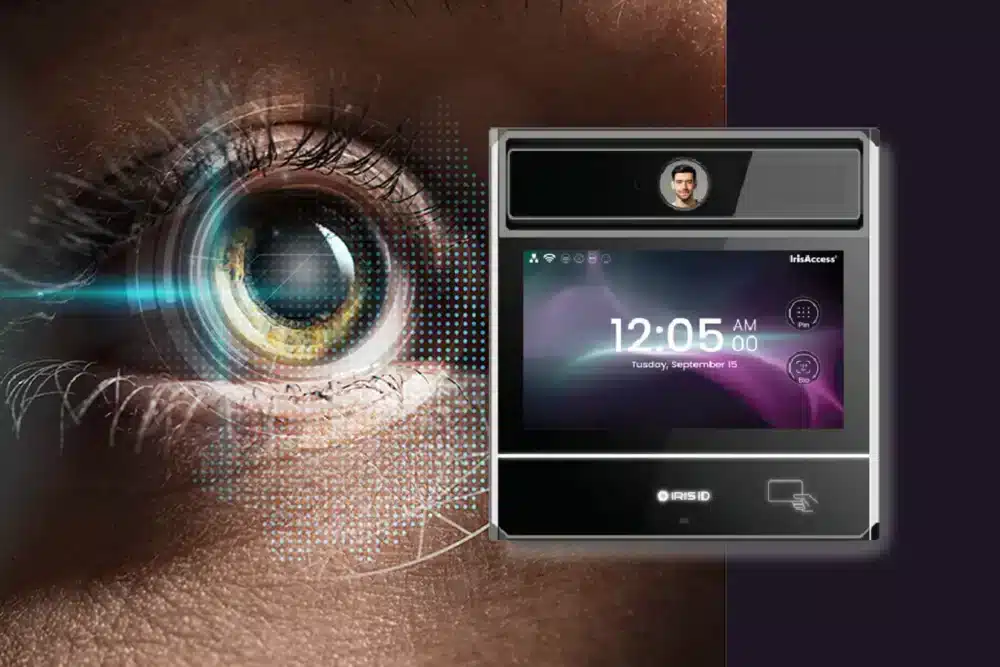
ID vision is one of the leading supplier of world-class Iris Recognition System for Time Attendance & Access Control. Get in touch with us for best price on complete range of Iris ID scanner.
Frequently Asked Questions
What is the main difference between iris recognition and retina scanning?
Iris recognition photographs the visible coloured ring of the eye from a comfortable distance using an infrared camera- non-invasive and complete in under a second. Retina scanning requires the user to hold their eye against a scanner eyepiece while an infrared beam maps the blood vessel network at the back of the eye. Iris recognition is the practical, commercially deployed technology; retina scanning is primarily used in medical diagnostics and ultra-classified government security.
Which is more accurate- iris or retina biometrics?
Both achieve extraordinary accuracy. Retina scanning’s False Accept Rate is approximately 0.0001%. Iris recognition, using Daugman’s IrisCode algorithm, analyses over 255 unique features versus retina scanning’s roughly 40 data points- giving iris systems a clear mathematical advantage in massive population cross-comparisons. In large-scale real-world deployments like the UAE border system, iris recognition has demonstrated consistent accuracy across trillions of comparisons.
Is iris recognition used in the UAE for border control?
Yes- extensively. The UAE uses iris recognition at all 32 air, land, and sea ports to screen visa-requiring travellers entering the country. The system shares data across a GCC-wide watchlist and has processed over 62 trillion iris cross-comparisons over a decade. It is one of the world’s largest and longest-running iris biometric deployments, built on the same algorithms available in commercial access control hardware today.
Can iris recognition be fooled by a photograph of an eye?
Enterprise-grade systems incorporate liveness detection- the scanner varies the intensity of its infrared illumination and monitors natural pupil dilation response, which cannot be replicated by a printed image or screen display. Modern iris readers from brands like HID Global and IDEMIA include this protection as standard.
Does wearing glasses or contact lenses affect iris recognition?
Standard prescription glasses generally do not prevent iris recognition because the infrared light used penetrates clear lenses. Some coatings and tints may slightly reduce capture quality, but modern readers compensate algorithmically. Standard contact lenses are typically fine as well. Heavily patterned cosmetic lenses can interfere with capture. For retina scanning, both glasses and contacts must be removed entirely before scanning.
Which brands supply iris recognition systems in the UAE?
Leading iris recognition brands available through ID Vision in the UAE include HID Global (Signo iris readers), IDEMIA (VisionPass with iris option) and Suprema (BioStation 3 with iris) Each integrates with standard Wiegand or OSDP access control infrastructure.
Is retina scanning available as a commercial access control product?
Commercial-grade retina scanning products for access control essentially do not exist at a viable price point. Hardware complexity, invasiveness, and slow throughput have prevented mainstream deployment. The few historical commercial retina products- such as those produced by Eyedentify in the 1980s and 1990s- are no longer manufactured for the access control market. All modern ocular biometric access control systems use iris recognition.
As an authorized distributor in Dubai, we supply Iris ID devices that businesses can trust. Every product we offer is sourced directly from global manufacturers and tested for performance. With a focus on long-term reliability and after-sales assistance, ID Vision remains the partner professionals across the UAE count on. Contact us to get the free quotation.