Direct-to-Card vs Retransfer Printers: Which Is Better in 2026?
The 30-Second Answer
Direct-to-card (DTC) printers are faster, cheaper to buy, cheaper to run, and ideal for standard PVC cards where a tiny white border is acceptable. Retransfer (also called reverse transfer or HDP) printers cost more upfront and per card, but deliver true edge-to-edge 600 dpi photo-quality output and are the only safe choice for smart cards, proximity cards and any credential with an uneven surface.
If you print mostly basic employee badges, school IDs, loyalty cards or visitor passes, choose direct-to-card. If you issue government IDs, banking cards, contactless access credentials or anything that must look premium and last for years, choose retransfer.
How Direct-to-Card Printing Actually Works
Direct-to-card uses a process called dye sublimation. A thermal printhead presses a colour ribbon against the PVC card. Heat from the printhead vaporises the dye, which then bonds to the surface of the card in three passes (yellow, magenta, cyan) plus a resin black and clear overlay panel.
It is essentially the same principle as a desktop inkjet, except the ink is solid dye and the medium is plastic. The printhead physically touches the card every single time. Models like the HID Fargo DTC1250e and the DTC4500e are the workhorses of this category.
Why That Matters
Because the printhead touches the card, two things happen. First, the printer cannot print all the way to the edge. There is always a 1–2 mm white margin. Second, any imperfection on the card surface (a chip, an antenna, dust, a slightly warped card) translates directly into a print defect or, worse, a damaged printhead.
How Retransfer Printing Actually Works
Retransfer flips the process. Instead of printing onto the card, the printhead prints the image in reverse onto a thin clear film called retransfer film or InTM film. A heated roller then fuses that film onto the card surface under pressure.
The printhead never touches the card. Ever. Models such as the HID Fargo HDP5000e and the flagship HDP6600 are built on this two-stage technology.
Why That Matters
Three big advantages flow from this. The image goes truly edge-to-edge with no white border. The image sits under a protective film layer, so it resists abrasion, UV fade and chemical wear far better. And because the printhead never makes contact with smart card chips, antennas or uneven surfaces, retransfer printers handle technology cards without damaging themselves or producing print shadows over chips.
Head-to-Head Comparison
| Feature | Direct-to-Card (DTC) | Retransfer (HDP) |
|---|---|---|
| Print method | Printhead contacts card directly | Print onto film, film fused to card |
| Resolution | 300 dpi (standard) | 600 dpi available (HDP6600) |
| Edge-to-edge printing | No, leaves 1–2 mm white border | Yes, true over-the-edge coverage |
| Print speed (dual-sided colour) | Up to 225 cards/hour (DTC4500e) | Up to 230 cards/hour (HDP6600)* |
| Print quality | Good, near-photo | Superior, photo-realistic, sharper text and barcodes |
| Smart / proximity card handling | Possible but causes print shadows and printhead wear | Ideal, no contact with chip or antenna |
| Card durability | Standard, image exposed | Higher, image protected under film |
| Printhead wear | Higher, may need replacement | Lower, printhead protected |
| Cost per card | Lower | Higher (extra film consumable) |
| Upfront printer cost | Lower | Higher (typically 2–3× DTC) |
| Card material compatibility | PVC, adhesive-back PVC | PVC, composite (PVC/PET), smart cards, uneven surfaces |
| Warm-up time | Almost instant | Traditionally 3–5 mins (under 60 sec on HDP6600 with iON tech) |
*The HDP6600 hit a milestone HID Global previously thought was reserved for DTC machines. Most other retransfer printers run 30–40% slower than equivalent DTC models.
Print Quality: Where Retransfer Pulls Ahead
If you place a DTC card and an HDP card side by side under office light, the difference is obvious. The retransfer card has crisper micro-text, deeper blacks, smoother skin tones in the photo and zero white border. The DTC card looks perfectly professional in isolation, but next to retransfer output it visibly loses sharpness, especially on logos and barcodes.
The technical reason is resolution and the film layer. Most DTC printers operate at 300 dpi. The HDP6600 prints at a true 600 dpi, which is four times the pixel density. Because the image is printed onto a smooth film rather than onto plastic with surface texture, dye dots stay precise instead of bleeding slightly into the card surface.
For staff badges in a 200-person office, no one cares. For a national ID card, a bank credential, or a university card that doubles as a payment instrument, the difference is the line between “acceptable” and “premium”.
Speed: The Old Rule Is No Longer True
For two decades the industry rule was simple: DTC is faster, retransfer is slower. That changed with the HDP6600. According to HID Global, the HDP6600 prints up to 230 cards per hour in YMCK with transfer, and reaches operating temperature in under 60 seconds thanks to its patent-pending iON instant-on technology. That makes it the fastest desktop retransfer printer ever built, and it actually outpaces several DTC printers in real-world batch issuance.
For everything below the HDP6600 tier, the old rule still applies. A DTC4500e will outpace an HDP5000e in raw throughput, and warm-up alone can cost retransfer users 5 minutes at the start of every shift.
Cost: The Honest Numbers
Three cost layers matter when you compare these technologies. Get all three on the table before you decide.
- Hardware cost. A retransfer printer typically costs 2 to 3 times more than an equivalent DTC printer from the same brand. An HDP6600 will sit at the top of the range, while a DTC1250e is the entry point.
- Cost per card. Retransfer needs both ribbon and InTM film. DTC needs only ribbon. Expect retransfer cards to cost 40–60% more per print than DTC cards over the long run, depending on coverage and lamination.
- Lifetime cost. DTC printheads wear from constant card contact and may need replacement within the printer’s life. Retransfer printheads are protected and rarely fail. Over 5–7 years of heavy use, this gap closes part of the consumable cost difference.
If budget is the single deciding factor and your card design is straightforward, DTC almost always wins. If total cost of ownership is what you care about, run the maths over the planned 5-year volume before choosing.
Smart Cards, Prox Cards and Uneven Surfaces: The Deal Breaker
This is the single technical issue where the choice is not a preference. It is a requirement.
Smart cards have a chip module embedded slightly below the surface. Contactless cards contain an antenna coil running around the perimeter. Both create tiny ridges that DTC printers cannot print over cleanly. You get a faint “shadow” where the chip sits, and over time the printhead striking that ridge wears out faster, sometimes requiring a costly replacement.
Retransfer printers solve this completely. Because the image is printed onto film and the film is then fused, the slight bump under the surface has no effect on print quality. This is why every serious smart card programme in banking, government and enterprise access control uses retransfer technology. If your cards are pulled from our smart card range or you encode them via HID Omnikey readers, plan to issue them on a retransfer printer.
Durability: Cards That Survive Daily Abuse
Retransfer cards consistently outlast DTC cards in the field. Three reasons.
First, the ink sits on the underside of the transfer film, sandwiched between the film and the card. Direct contact with sweaty hands, wallets, lanyards and reader slots happens against the film, not the ink. Second, the film itself is a thin protective layer that shields against UV fade and minor abrasion. Third, composite (PVC/PET) cards used with retransfer printers withstand the higher fusion temperatures and produce cards that flex without cracking.
For card programmes where the same credential will be in active use for 5+ years, this matters. For visitor passes printed today and binned tomorrow, it does not.
When to Choose Direct-to-Card
- You print under 10,000 cards per year, mostly standard PVC.
- Card design does not need to run all the way to the edge.
- You issue staff badges, school IDs, gym memberships, loyalty cards or visitor passes.
- You need the lowest possible cost per card.
- Smart card encoding is occasional, not the primary use case.
- You need fast warm-up for ad-hoc printing throughout the day.
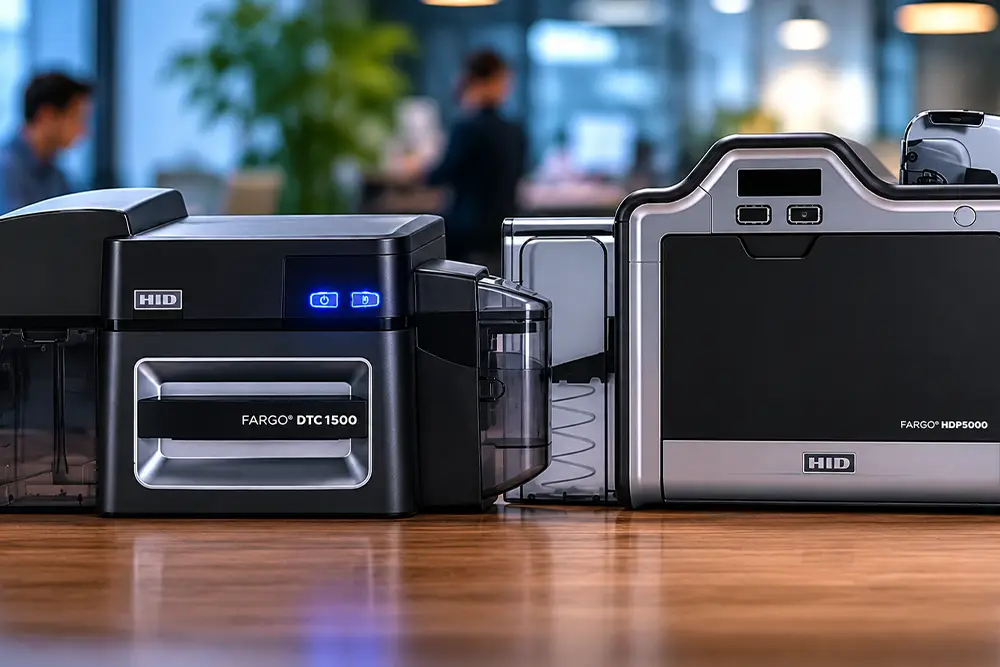
Recommended models: HID Fargo DTC1250e for small offices and schools, DTC4250e for mid-sized organisations, DTC4500e for high-volume DTC issuance, and the DTC1500 when you want enhanced visual security on a DTC budget.
When to Choose Retransfer
- You issue smart cards, proximity cards or any technology-embedded credential.
- Card design must run edge-to-edge with no white border.
- You need 600 dpi for micro-text, fine logos or security features.
- Cards must last for years in daily use.
- You are issuing government, banking, healthcare, university or high-security corporate IDs.
- Brand consistency and premium look matter.
Recommended models: HID Fargo HDP5000e as the versatile workhorse, and the HDP6600 when you need the fastest, highest-resolution retransfer printer currently on the market.
Industry-by-Industry Verdict
| Sector | Recommended Technology | Why |
|---|---|---|
| Government and national IDs | Retransfer | Security features, micro-text, edge-to-edge, smart chip |
| Banking and finance | Retransfer | EMV chip cards, premium look, regulatory standards |
| Universities and schools | Mixed | DTC for student cards if no chip, retransfer if combined with access control |
| Corporate enterprise | Mixed | DTC for staff badges, retransfer if HID iCLASS or MIFARE access cards |
| Healthcare | Retransfer | Durability against frequent handling and sanitisation |
| Hospitality and events | DTC | Volume, low cost per card, short card life |
| Retail loyalty | DTC | High volume, low complexity, no chip |
| Transport and metro | Retransfer | Contactless smart cards, daily abuse |
Maintenance: Two Different Realities
Both technologies need regular care, but the wear pattern is different. DTC printers need printhead cleaning every ribbon change because the head touches the card. Replace cleaning rollers, run a cleaning card, and inspect for debris.
Retransfer printers need attention to the heated transfer roller and the film path. The printhead itself rarely needs replacement, but the transfer roller is a serviceable part, and the dual consumable system (ribbon plus film) means more components to monitor.
In dusty UAE and wider Middle East environments, both types benefit from being kept in a closed cabinet or enclosed counter. Always change the cleaning card every time you change the ribbon. We have seen printers double their service life when this discipline is followed.
What About Other Brands and Technologies?
HID Fargo dominates the conversation because its product line covers both DTC and retransfer comprehensively, but it is not the only player. Team Nisca manufactures premium retransfer printers used heavily in banking. Dascom offers competitive DTC models with strong durability. SwiftColor is the specialist for oversized inkjet badge printing, a separate inkjet technology not directly compared here. HID Element serves industrial issuance.
The DTC versus retransfer question applies across all brands. What changes from one manufacturer to another is build quality, warranty terms, software ecosystem and local support. In the UAE, supplier proximity matters more than people realise. A printer with a 24-hour technical response from Dubai will always outperform a cheaper unit imported with no local backup.
Future Trends: Where the Technology Is Heading
Three shifts are reshaping ID card issuance in 2026 and beyond.
- Mobile credentials are not killing physical cards. At Intersec Dubai 2026, HID and other identity vendors confirmed that physical cards remain essential for high-assurance sectors. Mobile IDs are layering on top, with physical credentials acting as the cryptographic anchor. This means retransfer demand is rising, not falling, especially for cards that combine print and chip.
- iON-style instant-on tech is removing retransfer’s last weakness. The warm-up delay was historically the strongest argument for DTC in fast-turnaround environments. The HDP6600 has effectively closed that gap. Expect every major brand to follow within 2–3 years.
- Sustainability is becoming a procurement requirement. Wasteless lamination, refillable ribbons and ENERGY STAR certifications are now scoring points in government and enterprise tenders. Retransfer wasteless lamination (up to 40% less consumable waste on the HDP6600) is becoming a differentiator beyond just print quality.
Final Recommendation
If you take only one thing from this guide, take this. The right printer is not the most expensive one and it is not the cheapest one. It is the one that matches your cards, your volume and your useful life expectation.
Print standard PVC employee badges? Buy DTC and save your budget for software, encoding and ribbons. Issue smart cards, premium credentials or anything that has to last 5+ years and look the part? Buy retransfer and treat it as the long-term investment it is.
Still unsure? Send us your card sample, your annual volume and your encoding requirements. We have done this analysis for thousands of organisations across the UAE, GCC and Africa. Talk to our specialists at sales@idvisionme.com or +971 4 269 4620, or use the contact form for a no-obligation recommendation.
Frequently Asked Questions
Is a retransfer printer worth the extra cost?
Yes, if you issue smart cards, need edge-to-edge printing, or want cards that last 5+ years. For basic PVC badges with no chip, the extra cost rarely justifies itself, and direct-to-card delivers the same practical result.
Can a direct-to-card printer print on smart cards?
Technically yes, but the chip creates a visible print shadow and the printhead wears out faster from striking the raised chip area. For any volume of smart card issuance, retransfer is the safer and cleaner choice.
What is the main difference between DTC and HDP printing?
DTC (direct-to-card) prints ink straight onto the card surface using a printhead that touches the card. HDP (high-definition printing, or retransfer) prints onto a clear film first, then fuses that film onto the card with heat and pressure. HDP gives edge-to-edge coverage and protects the printhead from the card surface.
Which is faster, direct-to-card or retransfer?
Historically direct-to-card was significantly faster. The latest retransfer flagship, the HID Fargo HDP6600, now reaches 230 cards per hour and warms up in under 60 seconds, matching or beating many DTC printers. Outside that flagship class, DTC is still 30 to 65% faster on equivalent units.
Do retransfer printers need special cards?
Composite cards (PVC/PET blend) are strongly recommended for retransfer because they withstand the higher fusion temperatures without warping. Standard PVC cards can be used in some retransfer printers but may show edge curl over time.
How long does an ID card printer last?
With regular cleaning and genuine consumables, both DTC and retransfer printers last 5 to 10 years. Retransfer printers tend to need fewer printhead replacements because the head never touches the card.
What is the best retransfer printer in 2026?
The HID Fargo HDP6600 is the current benchmark, offering true 600 dpi resolution, up to 230 cards per hour, sub-60-second warm-up via iON technology and wasteless lamination that cuts consumable costs by up to 40%.
What is the best direct-to-card printer for a small office?
The HID Fargo DTC1250e is the most popular choice for small offices, schools and clubs. It is compact, plug-and-play, supports optional encoding and dual-sided upgrades, and offers excellent value for under 5,000 cards per year.
Is retransfer printing the same as lamination?
No. Retransfer fuses a thin print film onto the card as part of the printing process itself. Lamination is a separate, thicker protective layer (patch or full overlay) added on top, usually as an optional security and durability upgrade. Many retransfer printers can also laminate, but the two functions are distinct.
Where can I buy genuine HID Fargo retransfer and DTC printers in the UAE?
ID Vision is the authorized Platinum distributor of HID Fargo across the UAE, Middle East and Africa, supplying genuine printers, ribbons, films and after-sales support. Reach the team on +971 4 269 4620 or sales@idvisionme.com.
Related Resources from ID Vision
- Compare HID Fargo Printers: 2026 Buying Guide
- Best ID Card Printers to Buy in 2026
- Full HID Fargo Printer Range
- PVC Cards, Pre-Printed Cards and Smart Cards
- Bureau ID Card Printing Service
- Buyer’s Guide Hub
External References
- HID Global, HDP6600 Product Specifications
- HID Global, DTC4500e Product Specifications
- Intersec Dubai, Industry Security Exhibition
Author: ID Vision Technical Team. ID Vision is the authorized Platinum distributor of HID Fargo card printers in the UAE, Middle East and Africa, with over a decade of field experience installing and supporting both direct-to-card and retransfer systems across government, banking, education and enterprise.